| Reviews
& Testimonials
'A
gem. If you only read one more book this year, read this and give
it to the children and young people in your life...True story or
modern fable, the values are eternal and life enhancing. Making
a distinction between friend and enemy doesn't lead anywhere.'
Lifescape
Magazine
'A
Roaring Good Read'
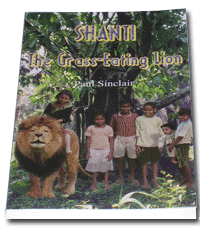
'Paul Sinclair's Shanti the Grass-eating Lion is an excellent
modern-day fable that will appeal to children and parents alike.
The story follows Shanti the talking Lion and the adventures he
has with the rural Indian children. The book contains an underlying
theme of encouraging children to develop good, moral characters
and a greater appreciation of the world.
'All
profits from the book will go to the Shanti Lion Children's Trust's
dedicated work to providing orphanages across the world and the
rehabilitation of child slaves and soldiers.'
Yoga
Magazine
'This story is told by a Holy
Man to some children in an Indian village. It is a story of love,
respect and abundant living! A lost lion cub is adopted by local
villagers but because they are poor, they can only feed him on fruit,
vegetables, rice, milk and grass. Despite this unusual diet, he
thrives until he is tempted by the local farm animals. How the villagers
deal with this dilemma, the subsequent change in Shanti's status
and the effect he has on those in trouble, make an unusual but life-changing
story for young and old alike.'
Margaret
Sawyer, Magnet Magazine
'Unconditional love emanates from every page
of this delightful story. The main character is Shanti, a lion who,
after being rescued as a cub and raised by people in a small village
in India, chooses not to eat meat in order to prove his love for
them. Shanti who in the story has a special relationship with the
“Creator of the Universe,” becomes a spiritual leader
to all who come into contact with him.
'The narrative, essentially a modern day fable which resonates across
religions and cultures, provides adventure and excitement; there
are goodies and baddies, and humor too (mostly provided by the antics
of Shanti’s rat friend, Manik).
'The children in the story respond to Shanti’s
wisdom and achieve some wonderful things, which in their turn may
prove inspirational to young readers. Early in the story, helping
an old widow harvest her crop is turned by Shanti into a game. Later
on, he saves the life of the money-lender who has been trying to
kill him. There is plenty of scepticism too: when a boy called Nanda
tries to get his friend Mohan involved in his plans to take food
from the town back to everybody in his village, as suggested by
Shanti in a dream, Mohan scoffs, “Don’t be silly; even
if there was such a thing as a grass-eating lion, and he could talk
to you in dreams, how can we feed hundreds of people? We are just
two small boys.’ But love and faith together, as we learn
from this fable, can work miracles...
'Sinclair
both wrote and illustrated the book to raise funds for the Shanti
Lion Children’s Trust, whose work at present is mainly based
in India. Details of “Shanti’s vision” is given
in an afterword. One of the organisation’s aims is for young
people to become involved in Action Clubs to make a difference,
starting from within their own communities. Sinclair neatly includes
an Action Club in his narrative, which should prove inspirational
- be ready for clamours of “Can we do that?”
'This
is definitely a book for sharing, whether as a family or a class.
It would lend itself particularly well to being an RE resource,
for its spiritual message resonates loud and clear, whatever one’s
religious persuasion.'
Marjorie
Coughlan, PaperTigers.org
See
also Marjorie's blog entry Books at Bedtime at PaperTigers through
this link.
'Jo read from Shanti to the children on our
first afternoon together. We started the day with our opening circle
in which each child lights a candle for our circle and we sing to
greet each other. We made a wishing tree for our yurt in that time
too. Then after lunch Jo led her session. She read to the children
and talked with them about Action Clubs. They decided to go 'love
raiding' to give appreciation to some of the adults who give a great
deal to make our camp work for everyone. I can't tell you much about
this because I ended up going off with one of the 5-year-olds to
follow him a-wandering. I met the group with water melon and apple
when they returned, all very excited and full of their adventures.
They wanted to hear more of Shanti's story and I think Jo might
have ended up reading the whole book if I had not rescued her at
the end of a chapter and suggested that we close our session now.
She looked pretty tired to me from holding the space, but she was
also lit up with joy and delight. Later in the camp she finished
reading the story, and though I don't think we made any more 'official'
excursions as an Action Club, many of the children continued with
random acts of kindness and senseless acts of beauty. Some of the
young boys cooked breakfast on the last day to help the cooks. We
are talking about feeding about 250 people. The gas canister ran
out while they were working and they had to fry dozens of eggs on
an open fire. They were magnificent. This was done by young boys
between 10 and 14.'
Fiona
Collins's account of using Shanti the Grass-eating Lion to run action
clubs at a Summer Camp
' A lovely story which encourages children
(and adults!) to see beyond outward differences, live peacefully
with one another and in harmony with the natural world. It is also
a reminder that in co-operation with each other and through trust
in that transcendent source of love and goodness, which some call
God - there lies the power to effect change in our world.'
Sheena
Gabriel; Lay Leader of 'Meadrow Unitarian Chapel', Godalming, Surrey
'I
LOVED your book. I read it in one sitting and it was so beautiful
it made me cry. I have given it to my Elementary teacher in our
Montessori school to read to her 8 to 11 years olds.
Sheila
O'Neill, Principal of St. Andrew's Montessori School
'...We
loved, loved, loved it. I had to keep hesitating as I read
aloud to my family because I was on the edge of crying! We
loved him so much.'
Lotah,
Australia
'...In
the end I couldn`t put it down and I particularly liked the
ending, which to me is really the beginning. I was, and still
am, inspired.'
Michael
Williams, College of Teachers, The Waldorf School of South
West London
|
|
Bookmark
or share this book
©
Shanti Lion Children's Trust: 2006 - 2011
This Web page may be linked to any other Web sites. Contents may
not be altered |